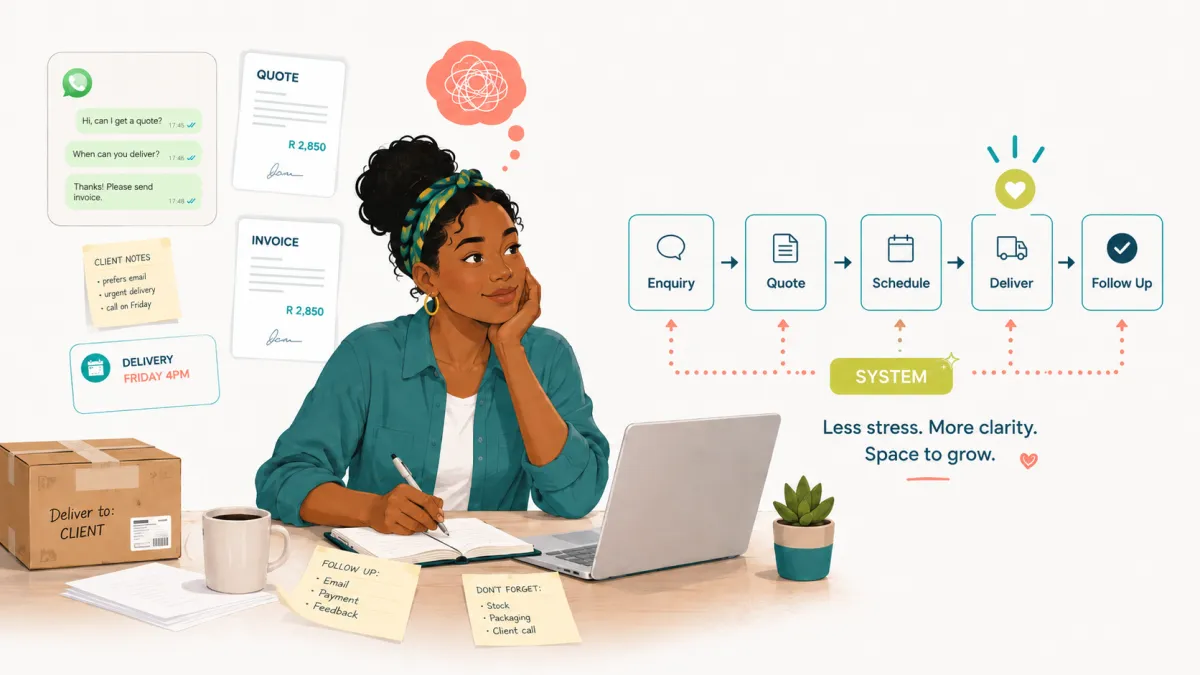
From Chaos to System
From chaos to system: free your business from firefighting
There is a particular kind of tired that most entrepreneurs and small business owners in South Africa know very well.
It is not only physical tiredness.
It is the tiredness of carrying too many open loops in your head.
The quote you still need to send. The client you promised to follow up with. The invoice you meant to check. The supplier issue that keeps moving to tomorrow. The content idea you had while driving that you never captured. The same customer complaint, returning in a different form.
And somewhere underneath all of that is a quieter, heavier thought:
"Why am I not better at this by now?"
If that feels familiar, please hear this clearly: this post is not here to shame you.
Whether you are building from scratch as a solopreneur or running a small business with a team, you are probably not struggling because you are careless, lazy, or bad at business. You are struggling because your business has grown around your personal effort, personal memory, personal energy, and your ability to rescue things at the last minute.
That may have worked in the beginning.
But at some point, effort alone becomes too expensive. Not only in money — in energy, in confidence, in family time, in creativity, in the dream that made you start the business in the first place.
This is where we need to talk about systems.
Not corporate systems. Not complicated software. Not another buzzword. Real systems — human systems — that allow value to move through your business without everything depending on you, every single time.
This is the third post in the MindHattitude foundational series. In the previous post, we looked at why speed to market is the real value driver — how quickly you can turn an idea into revenue. This post asks the next honest question: does your business have a system that allows that value to flow consistently once it starts moving?
What "system" actually means for a small business
The word "system" can sound cold.
For many business owners in South Africa, it sounds like corporate language, or expensive software, or something they "should" have built by now but never had time for.
So let us bring it down to earth.
A system is the connected way your business creates, delivers, and protects value for the customer.
It is not only a checklist. It is not only automation. It is not only a CRM or a project plan or a standard operating procedure. It is how the important parts work together.
How a customer finds you. How they ask for help. How you capture what they need. How you prepare the work. How you deliver it. How you check quality. How you communicate. How you follow up. How you learn from what went wrong.
In corporate spaces, we often used the phrase "systems thinking". Like most business phrases, it can sound bigger than it needs to. At its simplest, it means this: do not only look at one part of the business. Look at how the parts work together.
Your customer does not experience your business in departments. They experience the journey. If one part of that journey breaks, the customer feels the break.
A strong part does not mean the whole system works
Let us use a real example.
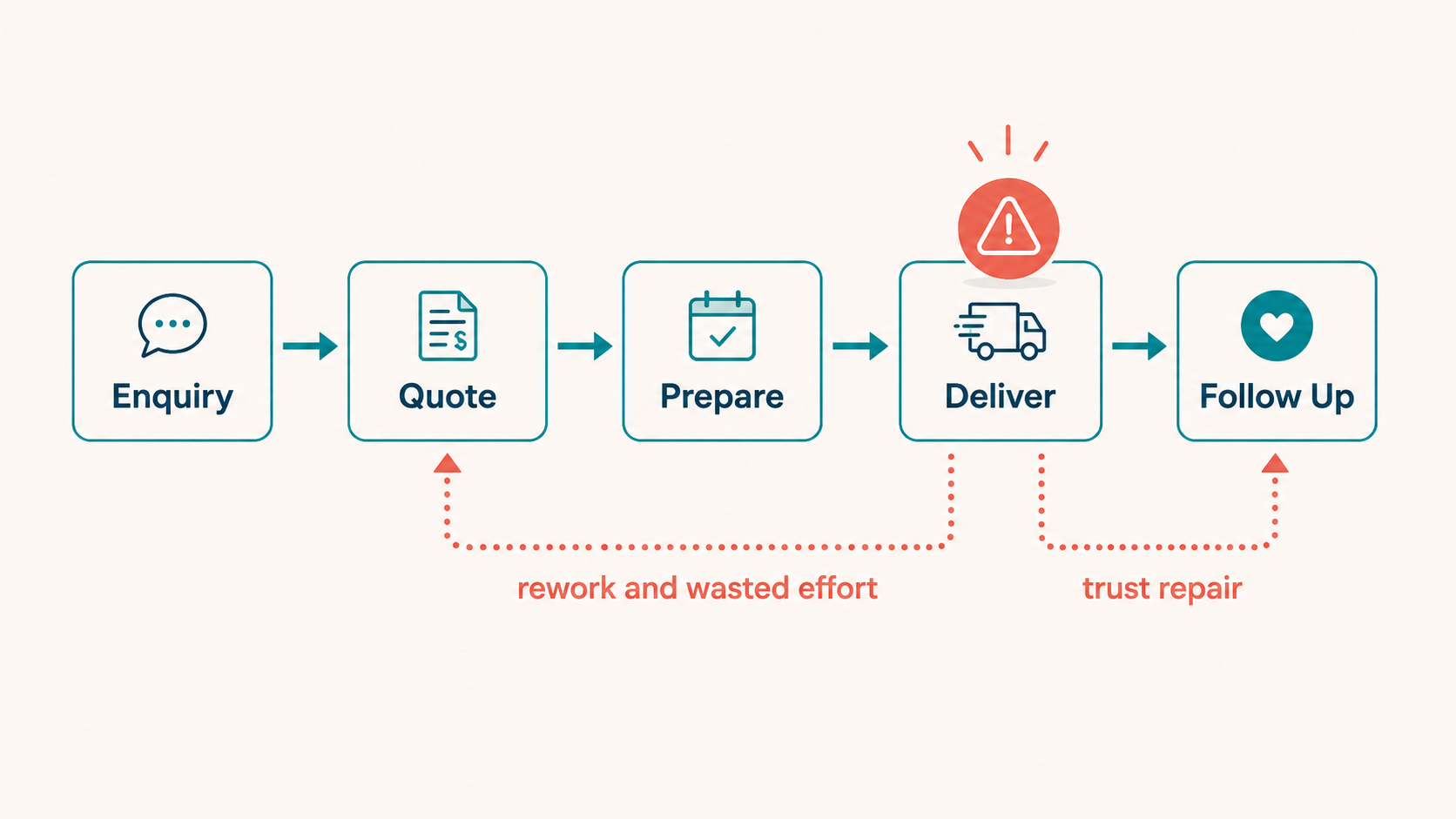
Sipho runs a small electrical contracting business in Johannesburg. His quoting process is excellent — fast, clear, professional. Customers feel confident from the first interaction.
But on-site delivery is inconsistent. Some of his team are trained; others are not. Quality checks depend on whether he personally visits the job. When he is stretched, things get missed.
The customer gets a poor result. They complain. Sipho apologises. He fixes it. He loses money on the call-back, and sometimes he loses the customer entirely.
From inside the business, it looks like separate problems: "The quoting works well. The team just needs more training. We need fewer mistakes."
From the customer's point of view, it is much simpler: "I trusted this business, and they did not deliver what they promised."
That is a system issue. Not because Sipho does not care. Not because his business has no value. The value is real. The issue is that the parts are not working together to protect the customer promise consistently.
Chaos is often care without structure
This matters.
Many business owners are not chaotic because they do not care. They are chaotic because they care deeply, but the care has no structure around it.
You reply to WhatsApps at 10pm because you care. You redo the quote because you care. You squeeze in the urgent client because you care. You carry the admin yourself because you do not want to disappoint anyone.
In the early days, that care can even be your advantage. Customers feel you. They feel your personal involvement.
But as the business grows, your personal care cannot be the only system.
Every promise depends on your memory. Every follow-up depends on your energy. Every quality check depends on your availability. Every improvement depends on whether you had a quiet moment to stop and think.
The problem is not that you care too little. The problem is that too much of the business depends on your care being available every minute of every day.
That is not sustainable. And it is also not what you wanted when you started.
Every business already has a system
Some business owners say, "I don't have systems."
But every business has a system. The real question is whether yours was designed, or whether it grew out of survival.
If client details live in WhatsApp, email, three notebooks, and your head — that is a system. An unsafe one, but a system.
If you create every quote from scratch — that is a system. If customer complaints are handled only when someone gets loud enough — that is a system. If training a new staff member means "watch me and we'll sort it out as we go" — that is also a system.
Most South African small businesses grow this way because the owner is busy serving, selling, fixing, delivering, and surviving. You build the plane while flying it. That is normal.
But at some point, the system that helped you survive starts limiting your ability to grow.
The five-part value flow check
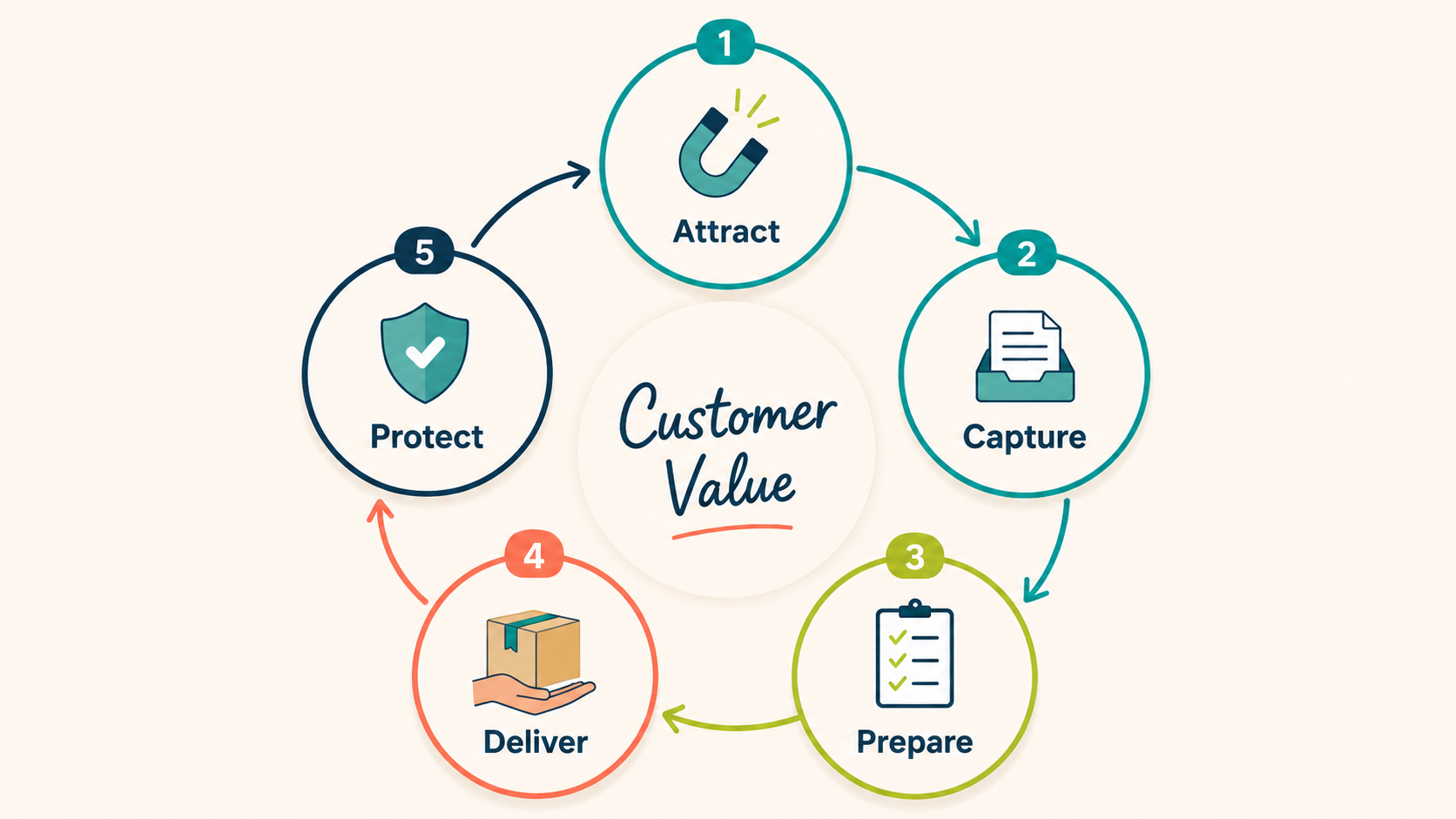
A practical way to see your business system is to follow the flow of value. You do not need a complicated diagram. Start with five questions.
1. Attract
How do the right people find you and understand what you offer? Word of mouth, referrals, social media, your website, WhatsApp groups, Google — whatever your channel is.
System question: Are the right people clearly seeing the value you offer, or is your visibility scattered and inconsistent?
2. Capture
How do enquiries, orders, bookings, and client requests get recorded? This is where many South African small businesses start leaking value — a customer sends a WhatsApp, someone calls, someone messages on Instagram, someone asks in person.
System question: Do important customer requests land in one clear place, or are they scattered across channels and memories?
3. Prepare
How do you turn the request into clear, scoped work? Quotes, briefs, order details, scheduling, task allocation, client notes.
System question: Does everyone know what must happen next, or does the business rely on someone remembering?
4. Deliver
How does the product or service reach the customer at the right quality?
System question: Can you deliver consistently, or does quality depend on who is working that day, how busy things are, or whether you personally checked?
5. Protect
How do you follow up, fix problems, learn from mistakes, and keep trust? This is where repeat business is either built or lost.
System question: Do you learn from what keeps going wrong, or do you keep solving the same problem one customer at a time?
Where value actually gets stuck
Once you look at value flow, you start seeing the business differently.
Good marketing with poor follow-up creates lost revenue. Easy ordering with poor fulfilment creates disappointed customers. Great delivery with weak invoicing damages cash flow. Friendly service with no record-keeping creates repeated mistakes. Fast sales with inconsistent training creates quality problems.
This is why it is not enough to ask, "Which person made the mistake?" A better question is:
Where is value getting stuck, delayed, damaged, or dropped?
That question changes the conversation. It moves you away from blame and toward design. And this matters, because most business owners do not have spare emotional energy for blame. They already blame themselves enough.
AI changes what is possible — but context still comes first
For many years, improving a business meant slow, expensive process work. Map the process. Interview everyone. Document the steps. Design the changes. Train the people. Months of work, often with a consultant charging R1,500 an hour.
That access was never equal. Large organisations could afford it. Most South African small businesses could not.
That has shifted.
AI gives small businesses access to support that previously felt completely out of reach. Not magic support. Not perfect support. But practical support — at a cost that no longer requires a boardroom budget.
AI can help you see patterns in complaints, draft standard communication, summarise scattered notes, create checklists, turn repeated tasks into reusable workflows, and prepare briefs that would previously have taken hours.
But here is the important thing: do not pour AI over chaos and expect clarity. Start with the value flow. Context before tools, always.
Ask first: what outcome are we trying to create? Where does human judgment matter? What is repeatable? Then ask where AI can support the drafting, sorting, summarising, reminding, or preparing.
That is the MindHattitude approach. Human first. AI second.

The C.A.L.M. system reset
If your business feels chaotic right now, do not start by trying to systemise everything. That will become another overwhelming project.
Start with one workflow, using the C.A.L.M. reset.
C — Capture the chaos
Write down where things feel heavy, repeated, delayed, or messy. Do not judge the list. Just get it out.
"I keep forgetting follow-ups. I rewrite the same messages every week. Client info is scattered across WhatsApp and email. Quotes take too long. Staff keep asking me the same questions. The same customer complaint keeps coming back."
A — Ask what promise is at risk
Every chaos point threatens a customer promise. Late quotes threaten revenue. Missed follow-ups threaten trust. Scattered notes threaten quality. Inconsistent delivery threatens reputation.
Ask: what promise is this problem putting at risk? This connects the chaos back to value — and it makes the urgency real without the drama.
L — Look for the repeatable pattern
Chaos often hides repetition. Ask: does this keep happening? Do I keep creating the same thing from scratch? Is this mostly drafting, sorting, checking, summarising, or reminding?
This is where AI becomes genuinely useful — not as a shiny object, but as targeted support for work that repeats.
M — Make one AI-smart workflow
Choose one workflow. Not the whole business. One.
Maybe it is this: every new client enquiry gets captured in one place, summarised into a brief, turned into a draft response, and added to a follow-up list.
Or this: every Friday, you record a five-minute voice note about the week. AI helps turn it into tasks, content ideas, and decisions for the following Monday.
One workflow creates real relief. And relief matters — because a calmer business owner makes better decisions.
You are not trying to become corporate
Many South African small business owners resist systems because they do not want to become slow, rigid, or cold. They started their business to get away from exactly that.
Understood. MindHattitude is not asking you to build bureaucracy.
You are not trying to become corporate. You are trying to become clearer.
Clearer about what the customer needs. Clearer about how work moves. Clearer about where quality is checked. Clearer about what AI can support and what still needs a human being.
A good system does not make your business colder. It makes it more trustworthy. It creates more space for the work you actually love — the work that made you start in the first place.
Your current way of working is not proof that you are failing
It is evidence that you have been carrying too much manually.
Chaos often begins as care. You care about the customer, the product, the promise, the reputation, and the dream. But care without a system eventually becomes exhaustion.
The opportunity now is to build better ways for value to flow.
Not so that AI can run your business.
So that you can stop running your business from survival mode.
Reflection question: Where in your business are you personally acting as the glue because the system is not yet strong enough?
Your action for the next 24 hours: Use the C.A.L.M. reset. Write down one area of your business that feels heavier than it should. Ask what customer promise it threatens. Identify what repeats. Then design one small workflow — even a simple checklist and a standard message template — that removes one piece of the weight.
Internal link ideas:
Blog 2: Why speed to market is the real value driver for entrepreneurs and small business — link here when you introduce the idea of value flow; readers who haven't seen this post need the foundation before the framework lands.
Blog 4 (upcoming): The mindset that makes AI actually work for small business — link at the close when you talk about human-first; this is the natural next step for a reader who is now asking "so how do I actually start thinking about this differently?"
