
The Game Has Changed - And Entrepreneurs and Small Business Finally Win
The Game Has Changed — And Entrepreneurs and Small Business Finally Win
For most of my working life, I watched the same thing happen over and over again.
A big company would hire a team of consultants — data scientists, business process engineers, analysts, the whole lot — to solve a problem that an entrepreneur or small business owner was quietly living with every single day. They knew the problem. They had ideas about the solution. But they couldn't afford the room full of expensive people, so they just kept going. Grinding. Doing the best they could with what they had.
That's not an entrepreneur problem. That's a structural unfairness that has existed for decades.
And here's the thing: that unfairness has just ended.
I Spent 35 Years Watching How the Other Half Operated
I'm Riana Engelbrecht, founder of MindHattitude. I spent 35 years in corporate South Africa — banking, petroleum, telecoms, consulting. Project manager. Agile coach. Programme manager. The kind of career that looks very solid on a LinkedIn profile and feels completely exhausting from the inside.
I wasn't just pushing paper. I was in the rooms where decisions got made. I watched large organisations spend hundreds of thousands on consultants to tell them what their own people already knew. I watched Agile — a way of working designed to make teams more collaborative, more responsive, and more human — get turned into a box-ticking exercise. Stand-ups, retrospectives, Jira boards. The ceremonies were there. The trust, the curiosity, the genuine collaboration? Not so much. Agile worked where its principles were applied. It failed where only the framework was implemented. I'll come back to why that matters enormously right now.
And I watched entrepreneurs and small business owners on the outside of all of that, looking in.
They didn't have access to the knowledge. Not because they weren't capable. Because knowledge was locked behind the price of consultancy, the complexity of enterprise tools, and the sheer number of specialised people you needed just to map a business process properly.
In 2025, I was retrenched. It was the best thing that happened to me. And I spent the next 14 months doing something I hadn't been able to do properly in 35 years of corporate life: learning.
Not completing courses. Not collecting certifications. Learning. Daily. Deeply. Applying things the same day I understood them. Asking questions I'd never had a safe space to ask before. Testing ideas at a pace that corporate would never have tolerated.
And what I was learning was AI.
What AI Actually Did for Me (And What It Can Do for You)
I want to be honest here, because there's a lot of noise around AI and I refuse to add to it.
AI did not make me smarter. It made learning safe and fast and contextual in a way it had never been before. It gave me access — as a solo person with a laptop and a strong opinion — to the kind of intelligence and capability that used to cost companies entire departments.
Business process engineering that once took weeks of consultant interviews? Now a focused session. Knowledge management that required a dedicated team? Now one person with the right tools can build and actually use it. Customer communication that once needed a copywriter, a brand manager, and a three-week sign-off process? Now consistent, on-brand, and done.
None of this requires you to be technical. It requires you to understand your own business — which you already do. It requires you to be willing to try something new — which, if you're reading this, you probably already are.
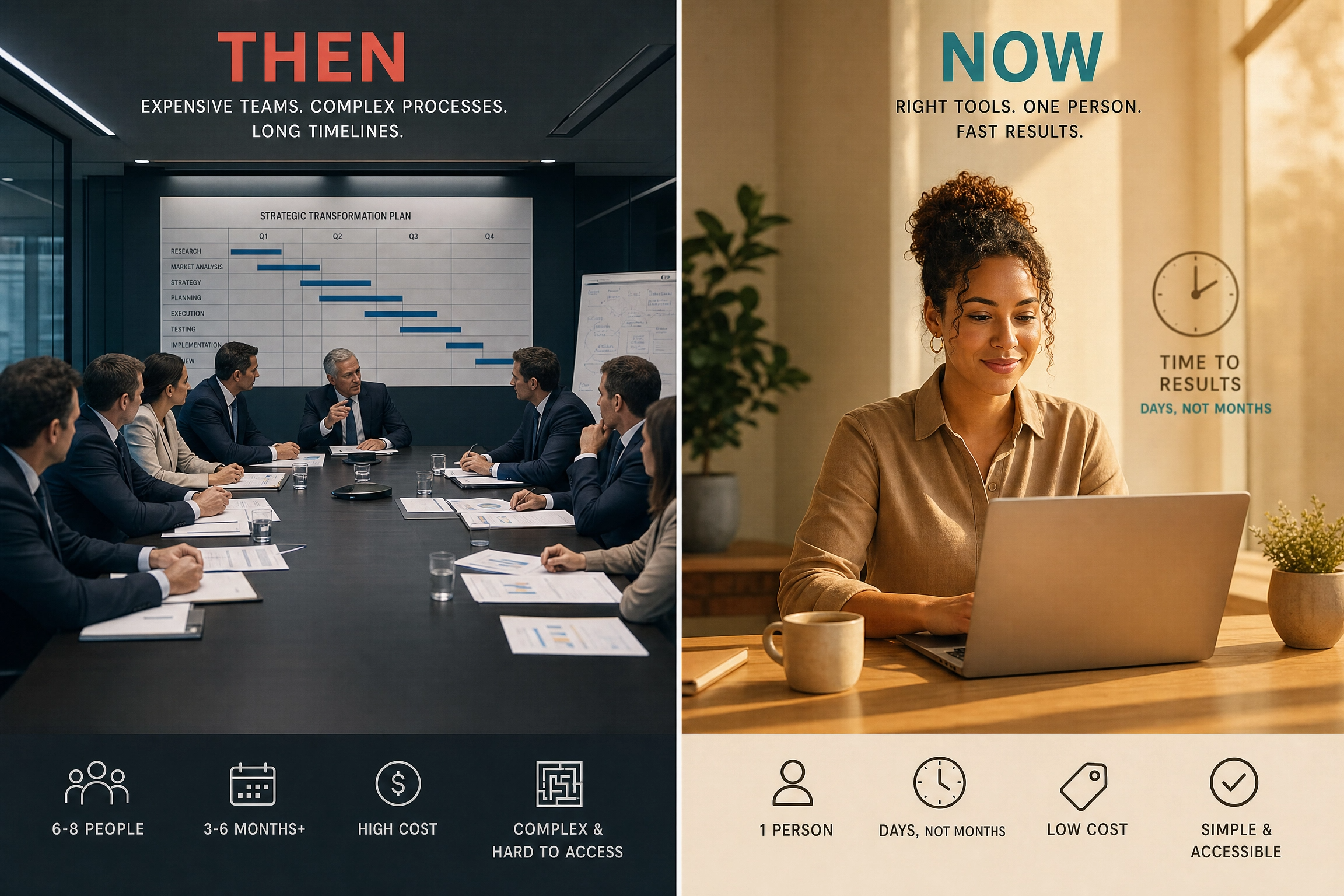
What changed is not the problems. What changed is who gets to solve them.
For the first time in business history, the knowledge and tools that were once the exclusive province of large, well-resourced organisations are now accessible to any entrepreneur or small business owner willing to learn how to use them. And not just accessible — affordable. We're talking R500 per person per month for access to tools that genuinely move the needle.
That's not a sales pitch. That's a structural shift, and it matters enormously in South Africa.
---
Why South Africa Makes This More Important, Not Less
I've heard the arguments. AI is a first-world luxury. Entrepreneurs and small businesses in South Africa have real problems — load shedding, access to finance, skills shortages, economic pressure. This is all fair. These things are real.
But here's what I believe with everything in me: AI doesn't just help people who already have advantages. It is one of the most significant opportunities to close the gap.
Think about what has historically kept knowledge behind closed doors in this country. Money. Access to the right institutions. The right connections. In some cases, deliberate exclusion from education. The systems that were supposed to level the playing field — from formal education to professional networks — have never fully done so.
AI democratises information. It doesn't care about your background. It doesn't ask where you studied or who referred you. If you have a question and you know how to ask it, you get an answer. If you have an idea and you want to test it, you can prototype it this weekend.
I want to be careful here, because I've seen the counter-argument: AI democratises information, but knowledge and wisdom are still earned through experience and mindset. That's true. AI gives you the map, but you still have to choose to walk the road.
That's exactly why MindHattitude exists.
Information without context is just noise. Tools without direction are just expensive admin. The thing that turns AI from a distraction into a business asset is mindset. It's the willingness to question how you've always done things. The ability to see your business clearly — the inefficiencies, the gaps, the opportunities — and act on that clarity rather than avoid it.
That's the work we do together at MindHattitude.

The Name Says Everything
MindHattitude is not a random word. It's three things fused together — and each one matters.
Mind is about brain-based learning. How we take in information, process it, and turn it into something we can actually use. Most of us were never taught how to learn. We were taught how to memorise, how to comply, how to pass. That's not the same thing. Understanding how your brain actually works — and working with it rather than against it — changes everything about how you engage with new ideas, new tools, and new ways of running a business.
Hat is about choice. You always have a choice about how you show up, how you respond, and what thinking you bring to a situation. In our work, putting on a different "thinking hat" means being willing to step out of the patterns that got you here and try a new perspective. This is harder than it sounds. Our default patterns feel safe. But growth happens when we consciously choose to see things differently.
Attitude is mindset. Not the motivational-poster version. The real version — the set of beliefs you carry about what's possible for you, what you're capable of, and whether change is worth the discomfort. Your attitude about AI, about learning, about your business — that's the single biggest variable in whether any of this works for you.
Mind + Hat + Attitude = MindHattitude. Brain-based learning, conscious choice, and the mindset to act. That's the combination that makes AI actually useful rather than just impressive.
AI Can Be Used for Good or Bad — That's Why Education Matters
Here's something I say clearly, without apology: AI is not neutral, and it is not inherently good.
AI can be used to cure diseases. It can also be used to spread disinformation. It can free up hours in an entrepreneur's week for family, creativity, and growth. It can also be used to manipulate, to deceive, to exploit. The same tool. Completely different outcomes. Depending entirely on the human holding it.
This is not a reason to be afraid of AI. It is a reason to educate yourself about it.
When I left corporate and started learning AI in earnest, one of the clearest things I realised was this: the people who will shape how AI is used in the world are not the governments making policy or the corporations building the models. They are ordinary people — entrepreneurs, parents, educators, small business owners — who either engage with this technology thoughtfully, or don't engage with it at all and let others make the decisions for them.
If you choose the second option, that's still a choice. And it has consequences.
Educating yourself about AI isn't just about improving your business. It's about being a responsible participant in a world that is changing whether you engage with it or not. It's about understanding enough to make good decisions — for yourself, your team, and the people you serve. And it's about modelling something important for the people around you: that technology is something humans direct, not something that happens to us.
At MindHattitude, we take this seriously. We are not here to hype AI. We are here to help you understand it, apply it ethically, and make it work for the life you actually want to live.

The Agile Lesson That Applies Directly to AI
Back to Agile for a moment — because this lesson took me years to fully understand, and it's directly relevant to where you are right now.
Agile is a way of working that emerged from software development in the early 2000s. At its heart, it's about building things incrementally, learning as you go, keeping teams close to the customer, and creating space for genuine collaboration between people with different skills. When it worked, it was genuinely transformative. Teams moved faster, built better things, and actually enjoyed their work.
When it didn't work — which was often — it was because organisations copied the practices without embracing the principles. They ran the meetings, created the boards, hired the coaches. But they didn't build the trust. They didn't change the power dynamics. They didn't genuinely involve the people closest to the work in the decisions. The frame changed. The mindset didn't.
The same thing is happening with AI right now.
Entrepreneurs and small business owners are adding AI tools. They're using chatbots and automation and content generators. Some are seeing real change. Others are spending money on subscriptions and getting nothing — or worse, adding complexity to an already chaotic operation.
The difference is not the tool. It's the mindset, the intention, and the application.
This is why at MindHattitude we focus on implementation, not just information. Knowing about AI is completely different from knowing how to apply it in your specific context, for your specific customers, in your specific business. One gives you knowledge. The other gives you results.
The Question I Get Asked Most Often — And the Honest Answer
People ask me: "Is it too late? Have I missed the window?"
Here's the honest answer: no, it's not too late. But here's what I won't sugarcoat.
If you are not yet thinking about how AI affects your business — if you're still in the "this doesn't apply to me" camp — you are already watching others move faster than you. Not dramatically, not overnight. But steadily. Consistently. The entrepreneurs and small business owners who are learning and applying AI right now are building advantages that compound. Faster decisions. More consistent delivery. More time for the work that actually requires their human presence.
The gap is growing. Not because AI is magic, but because learning and applying it is a skill. And like all skills, the earlier you start, the more it compounds.
We will not pretend otherwise at MindHattitude. We are not interested in making you feel comfortable about a choice that might genuinely cost you. What we are interested in is giving you the truth — and then giving you the practical steps to do something about it.
Because here's the thing the name is built on: the hat is yours. The choice is always yours. We can show you the landscape clearly. We can give you the tools and the knowledge to navigate it. But we can't choose for you.
What we can do is make sure that when you do choose to engage, you're not starting from zero. You're starting from here — with someone who has spent 35 years in business, 14 months deep in AI, and a genuine belief that this moment is one of the most significant opportunities South African entrepreneurs and small business owners have ever had.

What Comes Next on This Blog
This is the first post in a series designed to give you a real foundation — not just information about AI, but a way of thinking about your business that makes AI implementation make sense.
We'll be covering topics like:
- Why speed to market is the real value driver, and how AI accelerates it for entrepreneurs and small business owners
- How to shift from reactive firefighting to proactive business systems
- Why your mindset about change is the biggest variable in whether AI works for you
Every post is written for South African entrepreneurs and small business owners who are time-poor, smart, and done with vague promises. If that's you, stay with us.
Closing Thought
The game has changed. Not in a way that requires you to be technical, or young, or well-resourced. In a way that requires you to be curious, willing, and clear about what you want.
That's a game that South African entrepreneurs and small business owners — people who started something because they believed in something — are already equipped to play.
MindHattitude exists to make sure you know how.
Reflection question: What is one thing in your business that you know is inefficient — something you've been doing the same way for years not because it works, but because you've never had time to change it?
Your action for the next 24 hours: Write that one thing down. That's your starting point. Not a course. Not a strategy document. Just that one honest thing. That's where your AI journey begins.
Internal link ideas:
- Why Speed to Market Changes Everything for SA Entrepreneurs and Small Business (Blog 2 — business value and speed-to-profit)
- From Reactive to Proactive: How to Build Systems That Run Without You (Blog 3 — systems thinking)
