
Why Speed to Market Matters More Than Ever
Why Speed to Market Is the Real Value Driver for Entrepreneurs and Small Business
You have probably heard people say "work smarter, not harder." And if you are an entrepreneur or small business owner running on four hours of sleep and seventeen open browser tabs, you might have wanted to throw something at whoever said it.
Because the problem is not that you are not smart. The problem is that the gap between "this could work" and "this is actually earning money" is filled with so much friction that it wears you down before the idea even gets a chance.
That gap has a name. It is called time to value. And it is quietly one of the most important things you can manage in your business.
Whether you are building a business on your own or running a team, whether you are a solopreneur or a small business owner with staff depending on you — this applies to you. The structure of your business may look different, but the principle works the same way.
The Real Question Is Not "How Busy Are You?"
Most entrepreneurs and business owners I have spoken to are not lazy. They are exhausted. Doing everything. Wearing every hat. Up late, up early, doing the admin and the selling and the delivery and the chasing and the planning — all at once, often in the same hour.
But here is the honest question worth sitting with: How much of all that busyness is actually moving value to a paying customer?
Busyness and value are not the same thing. Activity and progress are not the same thing. Effort and outcome are not the same thing.
This is not a criticism. It is one of the most important realisations any entrepreneur or business owner can have. Because once you see the difference, you can start making decisions that actually change things.
What Business Value Actually Means
Let's keep this simple, because it often gets made more complicated than it needs to be.
Business value is what a customer is willing to pay for because it solves a real problem, improves their life, saves them time, or helps them move forward.
That is it.
It does not mean everything else in your business is pointless. Admin matters. Quality checks matter. Following up matters. Planning matters. But the question worth asking about all of those things is: is this helping value reach the customer faster and more reliably, or is it getting in the way?
Some admin is essential scaffolding. Some admin is just habit. Knowing the difference is where your time savings actually live.
Think about the chain that every piece of value in your business travels:
1.A customer has a need or makes a request
2.You understand what they actually need
3.You make a decision about how to respond
4.You create, source, or prepare the solution
5.You quality-check it
6.You deliver it
7.You get paid
8.You learn something and improve
The faster and cleaner that chain runs, the faster value is realised — as revenue, as trust, as reputation, as referrals. The more tangled it gets — with unclear steps, manual processes, re-doing things, delays, misunderstandings — the slower everything moves.
And for an entrepreneur or small business, slow is expensive.
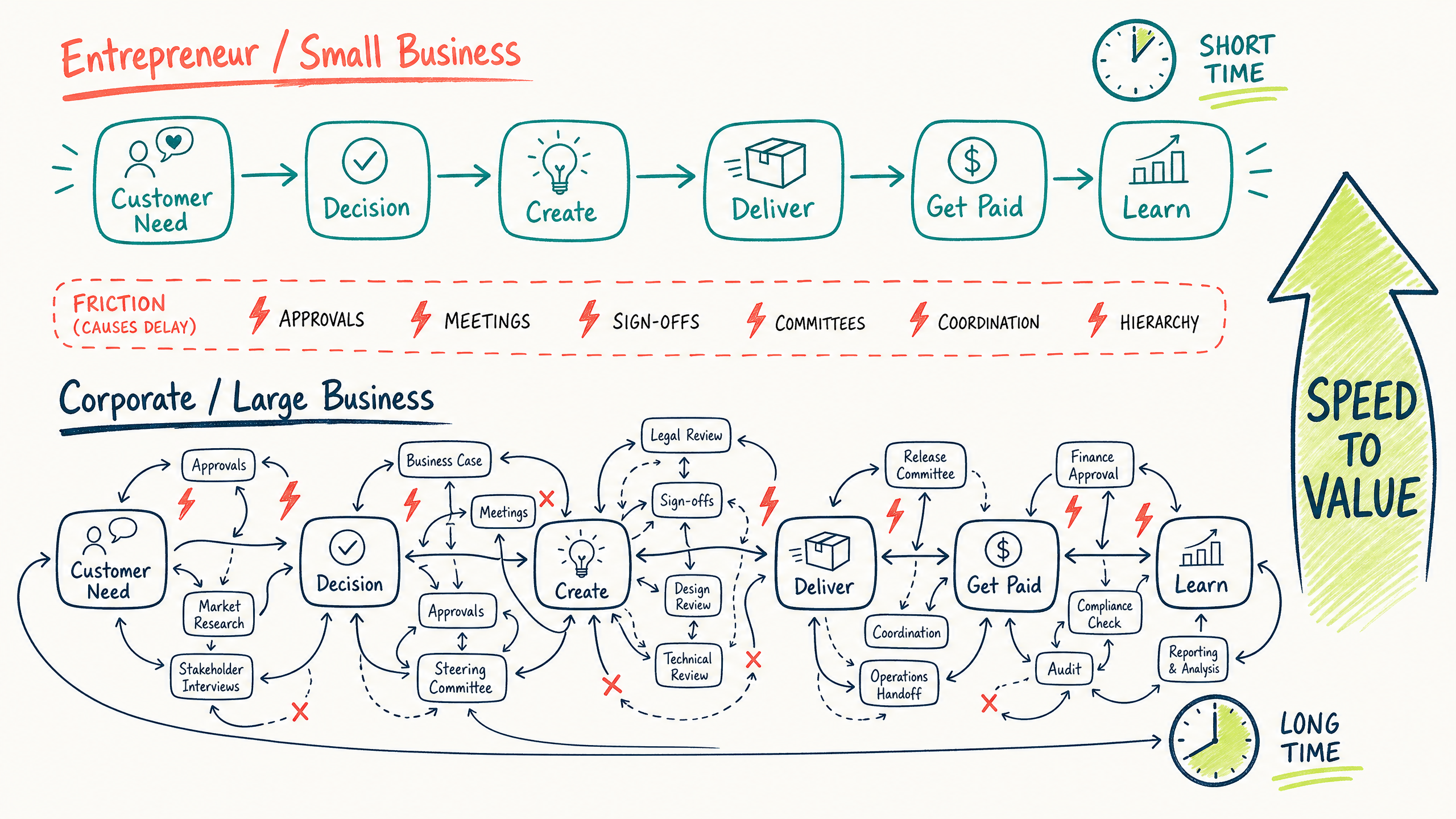
Big Businesses Often Get to Quality Faster — But Not Because They're Smarter
There is something that has always irritated me about the conversation around small businesses and corporates, and it is this: the assumption that big companies win because they are better run.
Sometimes that is true. But a lot of the time, big companies simply had more resources to throw at a problem.
When I was consulting inside large organisations, I watched businesses spend serious money — weeks of interviews, rooms full of analysts, external consultants charging by the hour — just to map out a business process and make a decision. The entrepreneur or business owner on the other side of that table had already made their version of the same decision a year ago. They were just too busy keeping the lights on to implement it properly.
Large organisations often have genuine strengths: more data, more specialists, more formal quality processes, more systems maturity. But they also carry real weight: slow approvals, competing agendas, layers of hierarchy, politics that delay decisions for months, and the kind of coordination complexity that makes even a simple change take a year to implement.
Entrepreneurs and small businesses have their own real strengths: they are close to their customers, they feel the problem directly, they can make a decision today and implement it tomorrow. That is a genuine advantage. The challenge has always been the lack of support — not having the analyst, the writer, the process mapper, the quality reviewer, the researcher.
And that is exactly what has just changed.
Entrepreneurs and Small Businesses Have a Hidden Advantage — and AI Is Amplifying It
Here is the honest shift I want you to understand:
For decades, large organisations could get to a higher-quality decision faster because they had the resources to support it — people, tools, time, systems. Entrepreneurs and small businesses had agility and closeness to the customer, but not the support layer.
AI is beginning to close that gap.
Not perfectly. Not magically. Not without human judgment and review. But meaningfully.
An entrepreneur or business owner who is willing to use AI thoughtfully can now access support that previously required multiple people or expensive consulting hours: drafting proposals, mapping processes, checking quality, testing ideas, summarising research, responding to clients faster, preparing onboarding documents, creating checklists, and building systems.
Think about what previously took a week of interviews and a team of consultants — a basic business process review. Today, you can have a structured, clear first draft of that process in a tool session, with prompts and frameworks that would have cost serious money to access a few years ago.
I am not saying AI replaces all of that. I am saying the time and cost barrier has shifted in a way that genuinely changes what is possible for an entrepreneur or small business.
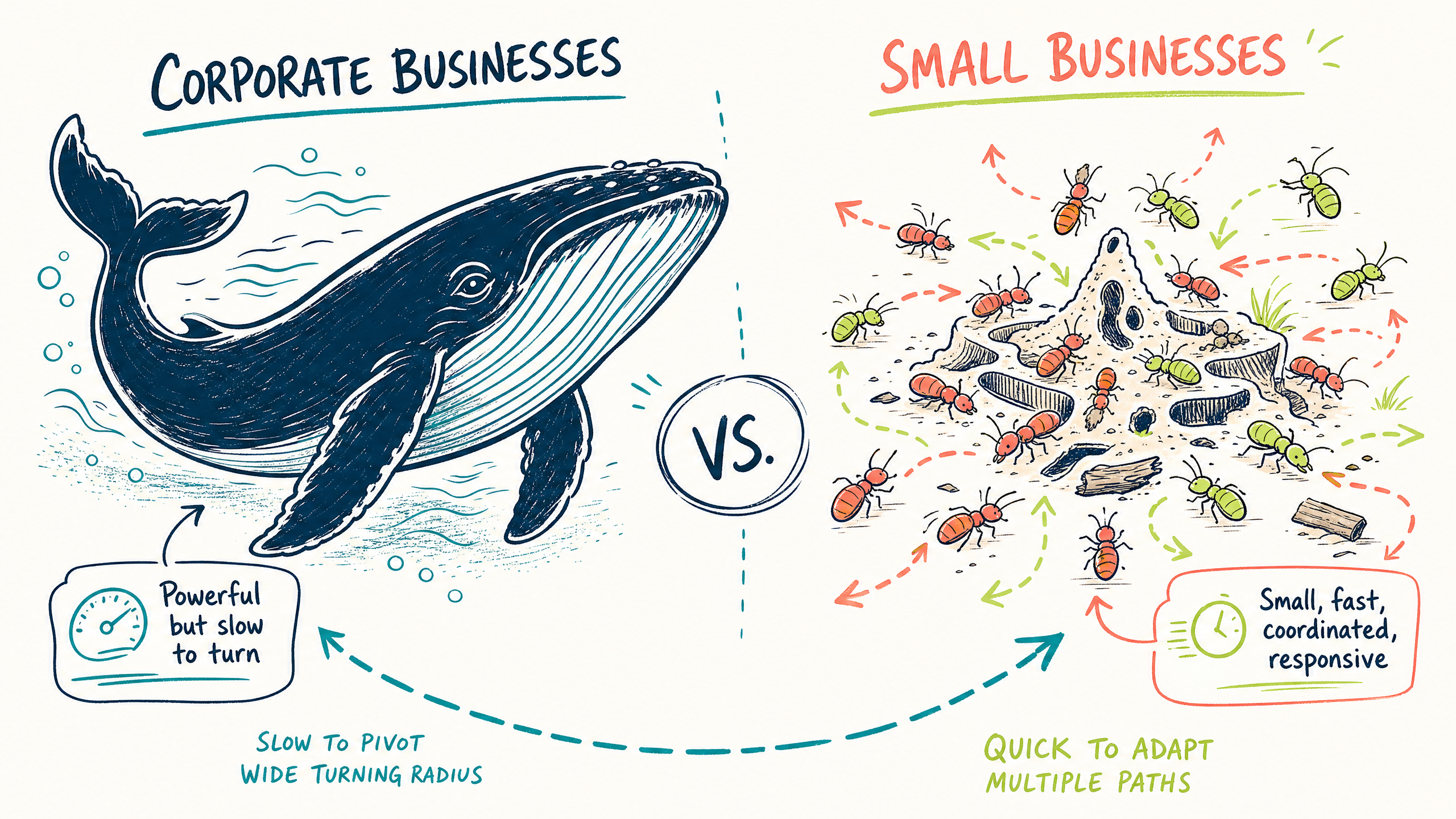
The Whale and the Termites
If I had to put this in one image, I would use this:
A corporate can be like a whale. Powerful. Impressive. Resource-rich. But when the environment shifts, it takes a long time to turn. The coordination, the approvals, the layers of sign-off — all of it adds drag.
A small business is more like termites. Small, responsive, coordinated, fast. Able to sense what is happening and adapt quickly. Not because they are reckless, but because the distance between noticing and doing is much shorter.
In the past, the whale often won because it had more muscle and more support. Today, AI gives the termites more intelligence, more structure, and more reach than they have ever had before.
The advantage now belongs to the business that is closest to the customer and most willing to experiment, learn, and move.
That is a description of most of the entrepreneurs and business owners I know.
AI Only Works If the Decision-Maker Is Open
Here is the part that does not get said often enough.
The tools exist. The access is there. The cost is genuinely low — for less than R500 a month, you can access AI tools that give you a level of support that was simply out of reach for most small businesses three years ago.
But AI does not create the advantage by itself. The advantage comes from a decision-maker who is willing to:
•Try something differently rather than default to the old way
•Ask better questions instead of assuming they know the answer
•Build new habits around using AI as a thinking and working partner
•Implement what they learn rather than consuming information without acting on it
•Stay human in the way they engage with customers, make judgments, and care about quality
The biggest bottleneck in most businesses right now is not the absence of good tools. It is the human relationship with change.
MindHattitude exists precisely at that intersection — helping entrepreneurs and business owners build the mindset, the habits, and the practical capability to use AI in their actual business context, not in a generic tutorial that has nothing to do with their daily reality.
A Simple Value Flow Check for Your Business
This is a practical framework you can use right now. You do not need a consultant or a system. You just need honesty and twenty minutes.
The Value Flow Check
Step 1: What is the real value the customer is paying for?Not the service name. Not the package. The actual outcome they want.
Step 2: Where does that value get stuck in your business?Where do things slow down? Where do things get repeated? Where do mistakes happen?
Step 3: What causes the delay?Is it unclear steps? Manual work? Waiting for information? A decision that only one person can make?
Step 4: What could AI help you draft, structure, check, or speed up?Pick one step in the chain. Just one. Where could a template, a checklist, a draft, or a structured process help things move faster?
Step 5: Where must human judgment stay firmly in charge?This is important. Not everything should be automated or AI-assisted. Know where your expertise, your relationships, and your judgment are the actual value.
Step 6: What can you test this week?Not next quarter. This week. One small test. One improvement. One process that moves a little faster than before.
A Quick Story from Cape Town
Zanele runs a small HR consulting practice in Cape Town. For years, her proposal process looked like this: receive a client enquiry, spend two to three days thinking about the scope, draft a proposal from scratch in Word, send it late, follow up by email, chase payment if they said yes.
She knew it was slow. She just never had the time to fix it.
In one working session, she mapped her value chain using a simple AI-assisted process. She created a proposal template with prompts for the key sections. She built a short intake checklist so that when an enquiry came in, she had the right information before she started drafting.
Her response time went from two to three days to four to six hours. Her proposals became more consistent. She stopped having to re-explain her pricing because the template did it clearly. She converted more enquiries because she responded while the client was still interested.
Nothing she did was technically complicated. It was a clear-eyed look at where value was getting stuck, and a practical decision to fix it.
That is what speed to market actually looks like for an entrepreneur or small business. Not rocket science. Just less friction.
The Game Has Changed — But Only If You Move
The tools are more accessible than they have ever been. The knowledge gap between entrepreneurs, small businesses, and large organisations is narrowing. The advantage of agility — which entrepreneurs and small business owners have always had — is now amplified by AI support.
But none of that matters if you stay busy instead of intentional.
The question is not whether AI is relevant to your business. The question is whether you are ready to look honestly at where value is getting stuck, and willing to experiment with something different.
That is where the game is won.
Reflection question: Where in your business does value slow down most between the customer's request and the moment you get paid?
Your action for the next 24 hours: Pick one product or one service you offer. Trace it from the first customer contact to payment received. Write down the two steps that take the most time or cause the most friction. Then ask yourself: what is one thing — a template, a checklist, an AI-drafted first version — that could make one of those steps faster or more consistent this week?
Internal link ideas:
•The Game Has Changed — And Small Business Finally Wins (Blog 1 — MindHattitude introduction and context)
•From Reactive to Proactive: How to Build Business Systems That Actually Work (Blog 3 — systems thinking for small business)
