AI Bridge
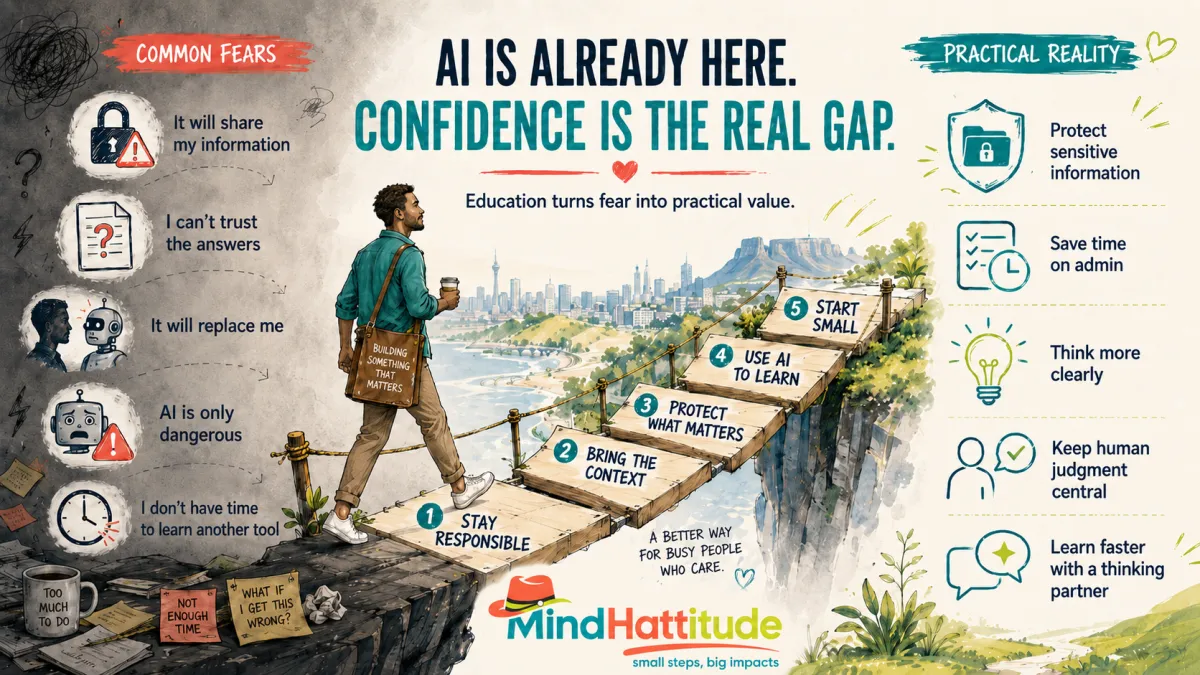
AI is already here. The real gap is confidence
South Africa is not asleep when it comes to AI. Not even close.
Whether you're building from scratch as a solopreneur or running a small business with a team behind you, you've probably already touched AI in some form — a chatbot, a summariser, a writing tool, maybe a recommendation that felt a little too accurate. The curiosity is there. The willingness to try is growing.
But something interesting is happening in the space between trying and getting real value. And that gap is worth understanding — because it's not the gap most people think it is.
If you've been reading this series from Blog 1, you've spent time looking at what drives real business value, how reactive processes quietly bleed time and money, and how building systems instead of surviving chaos changes everything. This post is about the mindset that makes any of that possible with AI. Not the tools. Not the prompts. The inner stance you bring before any of that.
The numbers say something that surprises most people
Here's something worth sitting with for a moment.
A 2025 Google/Ipsos study found that 70% of South African adults have used an AI chatbot — 25 percentage points higher than just two years before, and above the global average. Ninety percent said they are interested in learning more about AI.
Sage's SBBO research tells a similar story from the business side: 73% of South African SMBs have invested in AI. But only 47% are using it to actually drive revenue growth.
Read those two data points together and you start to see the real picture. The barrier is no longer access. It's not even awareness. The gap is between experimenting with AI and using it with enough confidence, context, and care to create real business value.
That's a very different problem. And it calls for a very different solution than another tool tutorial.

Why AI feels different from other business tools
If someone suggested you try a new toothpaste, you'd probably shrug. Maybe you'd try it, maybe not. Your brain would process it as a low-stakes, low-threat piece of information.
Tell that same person to try AI in their business. Watch what happens.
Suddenly it's not toothpaste. Suddenly your brain hears: threat, replacement, exposure, loss of control, privacy risk, identity challenge. For many business owners, their thinking, their judgment, their relationships, their reputation — that is the business. So when AI shows up and says "let me help you with that," the reaction isn't neutral. It's visceral.
That reaction is not irrational. It's human. And it makes complete sense given what we've been fed about AI — robots taking over, deepfakes, job losses, creepy algorithms. The stories around AI were fear-based long before the tools were useful.
Add the very real South African context on top of that. You're running a business in an environment that already demands everything from you: unreliable infrastructure, cost pressure, thin margins, small teams, the constant juggle. The last thing you need is something else that might waste your time.
So you're cautious. And cautious is not the same as wrong.
The question is whether caution becomes the reason to never start.
The real question is not "Will AI replace me?"
The fear of replacement is understandable, but it's the wrong frame. It pulls you into an argument you can't win, because no one knows exactly how automation will reshape every job in every sector over the next decade. That debate will not be settled here.
The better question is this: What parts of my work should never be handed over, and what parts am I exhausted from carrying alone?
That question is answerable. Right now. By you.
The human work — what stays with you
There are things AI cannot do, and should not do, in your business. Your values. Your lived experience. Your relationships with your clients. Your ethics. Your final judgment on what goes out under your name. Your intuition about what's right for your specific customer, your specific context. Your accountability for the outcomes.
These are not things that get automated. They're the things that make your business yours.
The heavy-lifting support — what you don't have to carry alone
Then there's the other category. The drafts you keep postponing. The client messages that sit in your head half-composed. The checklist that lives in your brain because you've never had time to write it down. The explanation you give to every new team member from scratch. The decision you're overthinking because you haven't been able to organise the information.
AI can take a meaningful load off here. Not because it knows your business better than you do. But because it can help you externalise what's already in your head so you can work with it more clearly.

AI does not fix a blurry business brain — it reveals one
This is the part most AI tutorials skip.
People start using AI expecting it to sort out their business clarity for them. They ask a tool to write their strategy, to define their customer, to decide what to offer. And the output comes back generic, vague, or off-brand. They conclude that AI doesn't work for them.
But the tool didn't fail. It had nothing to work with.
AI becomes significantly more useful when you bring clear context: who your customer is, what you sell, what "good" looks like, what you've already tried, what tone represents you, what constraints you're working within. When that context is present, the output quality shifts dramatically.
This is actually good news for small business owners. You don't need to become a tech expert to use AI well. You need to become a clearer business thinker. The two things reinforce each other.
In my own journey, AI didn't give me a business. It didn't replace 35 years of working with people, systems, delivery, teams, and change. What it gave me was a way to work with the mess. It helped me structure half-formed ideas, turn voice notes into usable content, test thinking without judgment, find gaps I couldn't see from inside my own head, and keep moving when the internal noise got too loud.
AI did not make me less human. Used with intention, it helped me hear my own thinking more clearly.
The mindset shift: from fear to stewardship
Here's the reframe that has made the most difference, not just in how I use AI but in how I teach it.
Stop thinking of yourself as an AI user. Start thinking of yourself as the steward of your business — and AI as one of the tools under your leadership.
That word "stewardship" matters. It keeps the human in charge. It frames your role correctly: you bring the context, the values, the judgment, and the accountability. AI brings the processing power, the drafts, the options, and the speed. Neither works well without the other.
To make this practical, here's the framework I come back to consistently:

The Human-First AI Mindset Framework
1. I stay responsible. AI can suggest, draft, compare, and summarise. But you decide. Every output that goes out under your name is your call.
2. I bring the context. AI does not know your business unless you teach it. Your customer, your tone, your constraints, your goals, your history — that's your job to provide. The quality of what you get back is directly linked to the quality of what you put in.
3. I protect what matters. Client information, private data, your IP, employee information, financial details — these are not things to casually paste into a public AI tool. Know what to share and what to hold back. This is table-stakes responsible use.
4. I use AI to learn, not to hide. The goal is not to produce polished-looking output while bypassing your own understanding. The goal is to become a more capable, clearer thinker in your business. Use AI to challenge your thinking, not to outsource it.
5. I start small. One task. One message. One idea. One decision. Not a full business transformation. A single small loop: try, check, improve, use, learn. This links directly to the agile principle that small, iterative experiments beat big, theatrical change every time. The principle works for AI adoption the same way it works for everything else.
A story most small-business owners will recognise

Rachel runs a catering business in Cape Town. She's brilliant with food and with clients. Her admin is slowly eating her alive.
Quotes, menus, supplier messages, follow-ups, staff instructions, social media — all of it lives in her head. When someone suggests she use AI to help, she feels a flash of irritation. So now I also need to become a tech person?
She doesn't start by automating her business. She doesn't sign up for a course. She picks one thing: a messy voice note about a quote that needs to go out, and she asks AI to help her turn it into a clear, professional message for a client.
It takes twelve minutes. The quote goes out the same day.
Nothing about her food becomes less human. Her care for her clients doesn't disappear. Her knowledge doesn't get outsourced. She simply stops carrying that one piece of thinking alone.
That's where it starts. Not with a transformation. With a task.
The real danger is not using AI badly — it's using it unconsciously
Because this series is built on honesty, it needs to name the other side too.
AI can absolutely be used badly. It can produce confident-sounding nonsense. It can reflect bias. It can expose private information if you use it carelessly. It can create shallow content at scale if you let it replace your thinking rather than support it. It can be used to mislead, to manipulate, and to publish things under your name that you haven't actually thought through.
The answer to all of that is not avoidance. It's responsibility.
Learn enough to use it thoughtfully. Keep humans accountable for outcomes. Know what not to share with a tool. Check outputs that matter. Don't publish AI work as original thinking if it isn't. Use it to support genuine value — not to fake it.
Human-first doesn't mean technology last. It means the human stays responsible for the purpose, the ethics, the context, and the decision. That's a standard you already hold yourself to in every other part of your business. AI doesn't lower that bar. It just adds a new tool to work with.
Your 20-minute AI confidence starter
Don't start with a tool. Start with a problem.
Pick one of the following — the one that's sitting heaviest right now:
A messy idea you haven't turned into action yet.
A client message you keep postponing because you're not sure how to phrase it.
A process that only exists in your head because you've never had time to write it down.
A decision you're overthinking and going in circles on.
An explanation you give repeatedly to new staff or clients that you wish you didn't have to repeat.
Then open an AI tool and try this prompt, filling in the brackets with your actual situation:
"I run a small business in South Africa. I want to use AI responsibly and practically. Help me think through this problem: [describe your problem]. Ask me five questions first so you understand the context before suggesting anything."
That prompt does something important: it teaches AI to work with your context before it reaches for generic answers. It also shows you what it feels like to be the one in charge of the conversation, not the other way around.

The gap is closeable — if you start
South Africa is not behind on AI. The curiosity is there. The experimentation is happening. What's missing for many business owners is the confidence that comes from one small experience of it actually working — in their business, on their terms, with their context.
That confidence doesn't come from a video. It doesn't come from reading another article. It comes from doing something small, checking if it worked, and deciding what to do next.
The world has changed. You're allowed to feel uncertain about that. But you're not powerless.
Start small. Stay human. Use the tool without letting the tool use you.
Reflection question: What is one part of your business that currently runs entirely from your head — and what would it mean for your time if it didn't have to?
Your action for the next 24 hours: Choose one item from the five-question starter list above. Open any AI tool. Use the prompt exactly as written, with your actual problem in the brackets. Don't judge the first output — just notice what it's like to have a thinking partner that asks you questions back.
Internal link ideas:
Blog 3 — "From reactive to proactive: how to build systems that run without you" — Link this when you discuss Thandi and the idea of tasks living in her head; readers who connected with that systems post will find this post gives them the mindset foundation that makes systems-thinking possible. A natural bridge.
Blog 2 — "Why speed to market is the real value driver for entrepreneurs and small business" — Link this at the section on the activation gap and getting real value from AI; readers who understand the time-to-value argument will see AI confidence as directly connected to their ability to execute faster. Reinforces the series arc.
